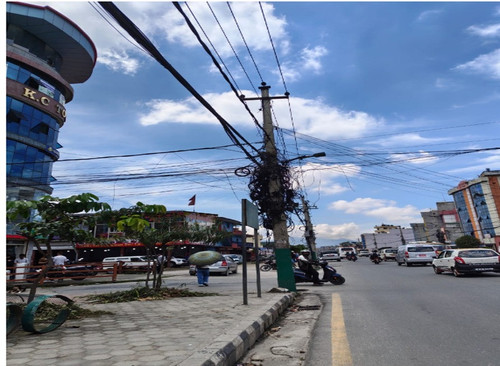
Kathmandu, 1 Bhadra: The campaign to manage wires tangled, broken and unused on roadside poles in major urban areas of Kathmandu Valley has gained significant momentum. According to the latest monitoring report of the Nepal Telecommunication Authority, wires have been bundled on most routes. However, the work of removing exposed wires, managing cable loops, placing tags that identify the service provider and improving finishing has not been completed.
The government is conducting a wire management campaign, saying that in addition to spoiling the urban beauty, unorganized wires increase the risk of fire, accidents and road safety. In the first phase, Tripureshwor-Kalanki-Kalimati, Jadibuti-Pepsicola, Tripureshwor-Jamal-Lazimpat, Samakhusi-Town Planning-Gongbu, Kirtipur and Old Baneshwor-Chabahil-Gaushala areas have been given priority.
The Authority had formed a special sub-committee on Jestha 29 to make the campaign systematic. The subcommittee includes representatives from the Nepal Telecommunications Authority, Nepal Electricity Authority, Kathmandu Metropolitan City, Metropolitan Traffic Police Office, Internet Service Providers Association Nepal (ISPAN), Nepal Telecom and Ncell Axiata.
The authority had directed the concerned service providers to mandatorily place identification tags on their wires. Various deadlines were also set to expedite the work of removing unused wires and tagging the remaining wires. After the expected speed was not seen in the initial phase, regular monitoring was started by appointing a 'lead operator' and focal person for each route.
Meanwhile, a high-level review meeting was held on Asad 11 and Shrawan 15 in the presence of Minister for Information and Communications Dr. Bikram Timilsina and Minister for Energy, Water Resources and Irrigation Biraj Bhakta Shrestha. After the meeting, responsibilities were redistributed among the service providers and a revised action plan was implemented. It was clarified which company would lead in which area, how many poles and distances would be worked on, and how much manpower would be mobilized.
According to the authority, although bundling work has been completed in the herbal sector, the final 'finishing' is poor. Tags identifying the service provider have been placed in very few places. 'Cable loops' are also visible. In the Baneshwor region, the situation is relatively satisfactory. Most of the open and loose wires have been removed. However, tags are missing in some places and some tags have been torn.
Although the wires have been 'bundled' in the Samakhusi region, the scene still does not look completely organized. There is no uniformity in tagging. It is seen that loop management and final 'finishing' also need to be improved. Although most of the wires have been bundled on the Lazimpat-Tripureshwor route, some open wires remain. Tagging has also not been completed in all areas.
On the Tripureshwor-Kalanki route, comparatively good progress has been made. Bundling has been completed in most areas and tagging is also organized compared to other routes, according to the authority. In some places, open wires still remain outside the bundles. Most of the wires have also been bundled in the Kirtipur area. However, the work has not been completed yet due to open wires and limited tagging.
The common problem seen in all routes in the NEA's monitoring is 'cable loops'. Even if additional cables are laid for service expansion or maintenance, if they are not managed, the view of the poles tends to look untidy even after the wire management. Therefore, clear criteria for placing and managing loops are needed.
Similarly, tagging has also been pointed out as a significant weakness of the campaign. Since there is no tag on all wires that identifies the service provider, it may be difficult to identify the ownership of damaged or unused wires in the future. In some places, tags have even been found to be missing and torn.
The NEA has stated that bundling will no longer be considered the basis for progress. The need to remove open wires, manage loops, complete tagging, and improve finishing after a final inspection of each route has been pointed out.
The NEA suggests that common infrastructure and underground utility ducts should be arranged to prevent the problem from recurring in the future. Since the problem will continue to recur unless the trend of adding new wires but not removing old and unused wires in a timely manner is stopped, a long-term system with regular monitoring and clear responsibilities is needed.