
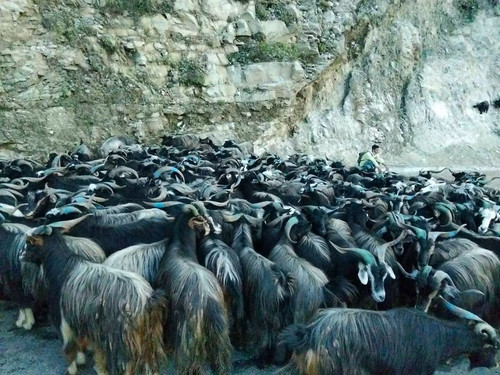
Kaski, October 13: A total of 14,800 sheep and mountain goats (chyangra) have arrived in Pokhara for the Dashain festival. Traders have brought these animals for sale from the Himalayan district of Mustang, as well as from Darchula, Bajhang, Bajura, and Dolpa. Special markets for the sale of these animals are currently operating at Simpani (Pokhara Metropolitan City-1) and Hemja (Pokhara-25).
According to Navaraj Adhikari, a veterinarian at the Livestock Services Branch of Pokhara Metropolitan City, 9,000 animals have arrived from Mustang, 2,000 from Darchula, 1,800 from Bajhang, and 1,000 each from Bajura and Dolpa. He noted that since some animals are still in transit, they are expected to reach the market a day or two before *Phulpati*. Local sheep from other districts of Gandaki Province are also brought to Pokhara for sale. Veterinarian Adhikari stated, "The sheep and mountain goats for Dashain have already arrived in Pokhara. While some traders have already brought them to the designated markets, many are keeping them in grazing areas around the city. We have received information that these animals will be brought to the markets within a day or two."
Meanwhile, a joint team comprising the Livestock Services Branch, the Veterinary Hospital and Livestock Service Office (Kaski), and the Animal Quarantine Office (Pokhara) has begun monitoring the health condition and sales distribution of the sheep and mountain goats. The inspection team reported that the majority of the sheep and mountain goats (chyangra) examined were found to be healthy. Continuous monitoring is scheduled to continue until the day of Phulpati.
Traders are required to obtain health certification from veterinary inspectors at the livestock service offices of their respective districts before transporting the animals. Arrangements have been made to isolate any sick animals found during inspections to keep them separate from the healthy ones.
Dr. Grishma Neupane, Chief of the Veterinary Hospital and Livestock Service Office in Kaski, stated that joint inspections are being conducted—focusing on health status, disease risk, and sales—due to the large influx of animals during the festive season. He urged consumers to pay attention to the animals' health when purchasing sheep or mountain goats. He advised selecting mountain goats that appear healthy—showing normal breathing rates, no excessive salivation, and possessing a glossy coat. "For animals transported over long distances—whether on foot or by vehicle—it is best to purchase them a day or two in advance and bring them home at least 24 hours before slaughter," Dr. Neupane said.
The Metropolitan City's Livestock Service Division reported that mountain goats are currently selling for up to Rs 1,250 per kilogram and sheep for Rs 700 per kilogram at the local markets in Pokhara.
There is high demand for the meat of mountain goats—raised in the cold climate of the Himalayan region—in Pokhara and surrounding areas during the Dashain festival. In addition to local supplies, large numbers of goats (*khasi-bokas*) are brought to Pokhara for sale from districts such as Surkhet, Arghakhanchi, Dang, Palpa, and Tanahun. Navaraj Devkota, a trader from Mugu, stated that it took him 11 days to transport *chyangra* (mountain goats) from Humla to Pokhara. According to him, the animals were transported partly on foot and partly by vehicle. He noted that transportation was more difficult this year compared to previous years due to incessant rain and landslides.
He said, "This time, we were troubled by rain and faced problems caused by floods. The market used to be good, but it isn't doing well right now." He explained that the price of *chyangra* is high because of the fees that must be paid to various local government units and livestock service offices along the route, as well as the costs incurred for grazing. RSS


